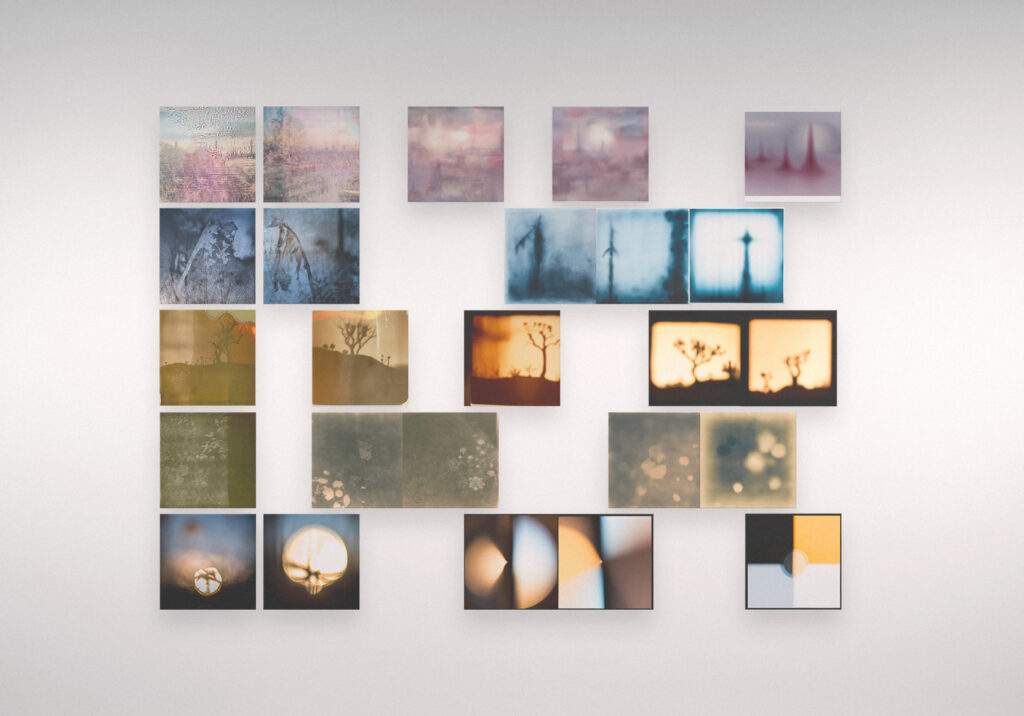
In 2023, Jennifer Pritchard and Patrick Corrigan began collaborating with a non-human partner: Dall-E, a generative AI model developed by OpenAI, which was able to create images based on textual prompts. Its development marked an important step in the AI revolution, and a key moment in their joint work, which led to the inception of the collective Aurora Wilder.
Corrigan and Pritchard crafted prompts and collated visual responses from the humans and the machine, creating layered images that were haunting as they were poetic. The project was included in the show I curated at the Brand Library and Art Center, If Memory Serves: Photography, Recollections and Vision, where it encountered the audience and generated important questions about the limits and potential of human imagination, as well as the machine’s capacity to engage with imaginative functions.
For the exhibition Expand and Contract: AI and Alternative Processes (opening: June 12, 2025), Aurora Wilder are once again testing boundaries, but this time, they consider ideas around inheritance in relation to the development of photographic practice, their own collaboration and their relationship with the machine, turning their attention to genetic formations, as a theoretical model and a framework to conceive their creative development.
What drew you to think about genetics in the context of image making?
In Aurora Wilder’s initial project, An Ambiguous Place, images were generated using DALL·E and written prompts. In their subsequent body of work, Inheritance, the images emerged from a foundational analog photograph. We were intrigued by the juxtaposition of two fundamentally different image-making processes—one driven by language and algorithm, the other rooted in the physical trace of light and film—coming together to create something wholly other. As we watched the images morph and evolve, they began to resemble the way traits pass from generation to generation in living organisms, shaped by genetic inheritance.
This observation led us back to high school biology—and to Gregor Mendel’s foundational experiments with pea plants in the 19th century, which laid the groundwork for modern genetics. While it may seem a stretch to compare the development of artificial intelligence to Mendelian genetics, we began to see meaningful parallels. In both cases, traits—whether visual elements or genetic characteristics—are passed down, recombined, and expressed with varying dominance and subtlety. In Inheritance, we noticed distinctions akin to dominant and recessive traits emerging across generations of images derived from a single analog source.
The work also evokes the classic nature vs. nurture debate. Mendel’s experiments deal with nature: the intrinsic, biological transfer of information. AI, by contrast, is nurtured—trained, fine-tuned, and shaped through programming and data. It is not inherited but taught, evolving through exposure, correction, and repetition.
If one accepts the metaphor, Inheritance can also be read through the lens of natural selection. Just as Mendel’s garden revealed the hidden architecture of heredity—where traits moved silently through generations under the slow hand of nature—so too does artificial intelligence reflect a new kind of evolution. While natural selection operates through random mutation and environmental pressure, AI evolves through human-directed iteration and optimization. It is cultivated in digital soil, where code replaces gene, and selection is no longer blind but intentional. The emergence of AI does not discard the principles of natural selection; rather, it extends them. It represents an evolution of evolution itself—an act of inheritance reshaped by design.
Do you think about genetics also when it comes to the evolution of your own creative practice?
If genetic evolution is a slow river carving the shape of life over millennia, and AI evolution is a swift current rerouting itself toward defined goals, then creative evolution is more like a winding path of ideas—shaped by curiosity, emotion, and lived experience. Each reflects a form of adaptation: biology responds to its environment, machines refine themselves through tasks, and artists adjust to the shifting world around and within them. Though each pathway differs in pace and method, all are driven by change, variation, and the search for something that works—whether for survival, function, or meaning. It was in this spirit that we sought to understand what we were witnessing in the evolving output of the Inheritance project.
Did the turn toward DNA and its visual representation allowed you to talk about something that was new to your practice?
As artists, our individual practices explore the human relationship to the universe through distinct but complementary lenses. Corrigan’s work centers on fundamental communal needs—belonging, connection, and purpose—and how these needs take shape within individuals and across the broader terrain of a fractured culture. Pritchard’s practice investigates life and loss, memory and dream, using a wide-ranging photographic and literary toolkit. Our collaborative work as Aurora Wilder departs from our solo practices by engaging with questions at the intersection of philosophy and metaphysics. Through AW, we explore complex themes such as truth, reality, and existence—driven by curiosity and a shared impulse to examine the world through multiple, often conflicting, perspectives.
Our conversations about DNA, artificial intelligence, and the metaphorical parallels between biological and technological evolution deepened our understanding of AI—not only as a subject, but as a tool. We approach it not as a means of deception or mere enhancement, but as something additive, something that can expand the boundaries of creative inquiry. AI is already embedded in many of the programs we use daily—often silently, and without our explicit consent. Through Inheritance and other AW projects, we aim to make its presence more visible, more knowable—to engage with it consciously, critically, and creatively.
Can you talk a little bit about the generational component within the collective as well?
Corrigan is a Xennial and Pritchard belongs to Generation Jones—both cusp generations shaped at the intersection of cultural, economic, and technological upheaval. They carry the residue of one era’s values while absorbing the uncertainty and contradictions of the next. Neither generation was defined by the clarity of a dominant identity; instead, they functioned as buffers, bridging seismic shifts in the social and technological landscape. Both Corrigan and Pritchard span the analog and digital divide—Corrigan, as part of the first generation to grow up with digital technology, and Pritchard, with the perspective and grounding of a pre-digital world. This duality informs their work in distinct but complementary ways.
Their shared orientation toward the “middle way”—a search for balance between what was, what is, and what might become—anchors their collaboration. It’s a perspective shaped not only by generational nuance but also by parallel backgrounds in design and business, providing a common foundation from which their artistic inquiry evolves.
How did you develop the work process with Dall-E? Did it change over time?
Our first installation was generated through word prompts; the second emerged from image prompts. Together, these two bodies of work trace the arc of DALL·E’s lifecycle and coincide with a pivotal moment when AI became widely accessible—no longer requiring coding expertise, but inviting broader creative engagement. As DALL·E evolved, so did the nature of its output. With increased use, the visual language began to shift—becoming more derivative, more entangled with the collective noise of mass input. The imagery grew murkier, less distinct. This evolution reflects not only the system’s development in a non-sterile environment but also a broader truth: nothing remains static. Not the tool, and not us.
Stasis is an illusion. As artists and as humans, we exist within systems—biological, technological, cultural—that are in constant flux. Our responsibility is to respond, adapt, and shape change with intention and awareness.
Do you also think about the evolution of your own collaboration in genetics terms?
Until this body of work, our approach had been largely intuitive—rooted in personal instinct and experience. We often considered the forces shaping our practice through the familiar lens of nature and nurture, but typically outside the context of collaboration. This project prompted us to reexamine those concepts not just as personal frameworks, but as dynamic forces at play within the creative process itself—between artists, tools, and evolving systems of meaning.
What did you learn about AI while working with Dall-E that was unexpected?
Each of the projects we’ve undertaken involved extensive research—research that allowed us to engage with both sides of often polarized debates, without letting fear be the guiding force. We grounded our inquiry in historical perspectives drawn from artists like Christian Boltanski, the expansive philosophical insights of Bill Viola, and the contemporary technological outlook of thinkers like Mo Gawdat. We read nearly every major article published on the subject during that time.
Corrigan brought a deep understanding of systems and technology, offering insight into the mechanics behind the tools we were using. Pritchard, as the elder of the pair, discovered an unexpected resonance with a world she had once viewed from the margins of a pre-digital life. And, as with any meaningful collaboration, part of the richness came from pushing, questioning, and expanding one another’s perspectives—each time with curiosity, sometimes with challenge, always with respect.
Is there something you would like people to know about working with generative AI?
At the core of our practice is a commitment to respect and self-governance. The work we create is proprietary, original, and deeply reflective of our individual and collective perspectives. In an era where technological tools are evolving faster than our cultural frameworks, we believe it is essential for artists—and all humans—to engage with these tools consciously. If we are to coexist meaningfully with technology, we must understand how to use it with intention, rather than be passively shaped or directed by it. This means holding space for both truth and imagination, and ensuring that what we make reflects not just technical capability, but human integrity.