Thresholds 2026: Up Close and Personal
May 7, 2026 – May 31, 2026
LACP at the Helms Design District
LACP’s annual street photography is coming back to the Helms Design District in Culver City with nighttime projections of images by photographers from across the world. This year, the exhibition moves our eyes from the screens to one another, to explores how street photography shapes unscripted moments and promotes human connection.
Top Prize Winners
1st Place: Eric J. Smith
2nd Place: Rick Musto
3rd Place: Carl Young
Honorable Mentions
Eliot Allen, Hanna Armour, Mia Baccala, Melanie Chapman, Jeff Evans, George Feucht, Rohitha Gunetilleke, Richard Hay Jr, Dean Hendler, David Herman, Avery Junius, Nancy Kaye, Poul Lange, Patricia Lemke, Dana Lina, Suz Lipman, Rick Musto, Carl Pfirman, michael rababy, Christopher Reale, Eric M. Renard, Brian Roberts, Bradley Ross, Landon Takano, Greg Tamura, Jack The Wolfman, James Yocuté
Juror
Michaela Norah Mohrmann, is the assistant curator at UC Irvine Langson Orange County Museum of Art
Opening Reception + Panel Discussion (In-Person)
Thursday, May 7, 2026 at 6:30pm @ Helms Design District, 8745 Washington Blvd. Culver City. RSVP HERE.
Exhibition Run Dates
May 7 – May 31, 2026 – Hosted on the LACP website and projected at the Helms Design District, 8745 Washington Blvd. Culver City.

About
Street photography is more indispensable than ever. As digital technologies, social media and Artificial Intelligence drive a collective disconnect, street photography—with its emphasis on relationship, sensorial experience and human connection—seems to offer a much-needed antidote.
Thresholds 2026: Up Close and Personal moves our eyes from the screens and back to one another and explores how street photography shapes conversation and unscripted moments; capturing the light, color and unexpected shadows of layered streetscapes. This exhibition thinks about the gaps between the eerie of sleekness of AI generated images and the raw power of candid snaps. It thinks about how buildings redefine movement in the space, the powers of timing and the vitality of visual storytelling.
The Juror
Michaëla de Lacaze Mohrmann is a Franco-Peruvian American curator and art historian. Since 2022, she has been assistant curator at UC Irvine Langson Orange County Museum of Art. Prior to this, she worked as associate curatorial director at Pace Gallery and held curatorial fellowships at the Museum of Modern Art, New York and National Museum of Korea. Her writing has appeared in Artforum, ArtMargins, ArtAsiaPacific, and publications for The Jewish Museum, Langson Museum, Museum of Fine Arts, Houston, and Museum of Modern Art, New York. She holds a BA in Art History & Architecture from Harvard University and a PhD in Art History & Archaeology from Columbia University, where she studied modern and contemporary art with an emphasis on Latin American and Latinx art.
Juror Statement
Though evincing disparate aesthetics, all three winning photographs of Thresholds: Up Close and Personal use the rawness of street photography to emphasize the physicality of their chosen subjects— the body’s movement, hapticity, and posture—and convey emotional complexity. Their focus on an individual’s embodied condition does not come at the cost of evocative context. Through considered compositional choices, each photograph highlights telltale details that reconstruct the world of a particular demographic group or subculture. The works are thus portals into the individual and collective psyche—double thresholds, in other words. The poignant narratives suggested by the photographs’ protagonists extend beyond the particularities of the self without divagating into hackneyed generalities on the human condition. Rather, they are firmly stitched to the here and now of American cities, showing where the urban social fabric frays and—in the case of the first-place winner—mends itself.
In Overheating, which obtained third place, a steaming car engine becomes a metaphor for the barely contained frustration of a hardened, tattooed man in the foreground. Crouched over the handlebar of a scooter, his fixed gaze evokes the murderous intensity of an apex predator on the verge of pouncing on his prey. In the middle ground, four men surround the broken car that is the ostensible cause of this anger. Dense and compact, the photograph foists the viewer into this tense, claustrophobic setting, where men are as tightly packed as the motor parts beneath the hood. At a time when public discourse has condemned “toxic masculinity” as much as it has affirmed a “crisis of masculinity,” Overheating registers the turmoil weighing on men but refrains from offering facile explanations or quick fixes. Instead, the photographer bears witness to the trouble, and the viewer is left wondering if it will all cool off.
The second-place photograph, Breaktime on the Strip, depicts a street performer who has removed his Minnie Mouse costume to sponge the sweat from his brow. Though character impersonators are meant to be conspicuous, the photograph delays our recognition of the man by placing him off-center the better to capture more of the colorful signage for casinos, Hollywood movies, and fast food chains that surround him. Against such a backdrop, his Disney costume becomes a form of camouflage. The momentary hiddenness of the photograph’s only human being underscores the sociopolitical invisibility and economic precarity of this type of worker. In fact, the possibility of upward mobility is symbolically foreclosed, as the dejected man stands out of the path leading to an ascending escalator—a patent metaphor for the social ladder. The photograph’s central irony is not that the ultra-feminine, eternally smiling Minnie Mouse is played by a scowling, mustachioed man but that the comforts of the American Dream so loudly sold by the Strip’s advertisements can only be produced for some through the exploitation of those preemptively excluded from that dream.
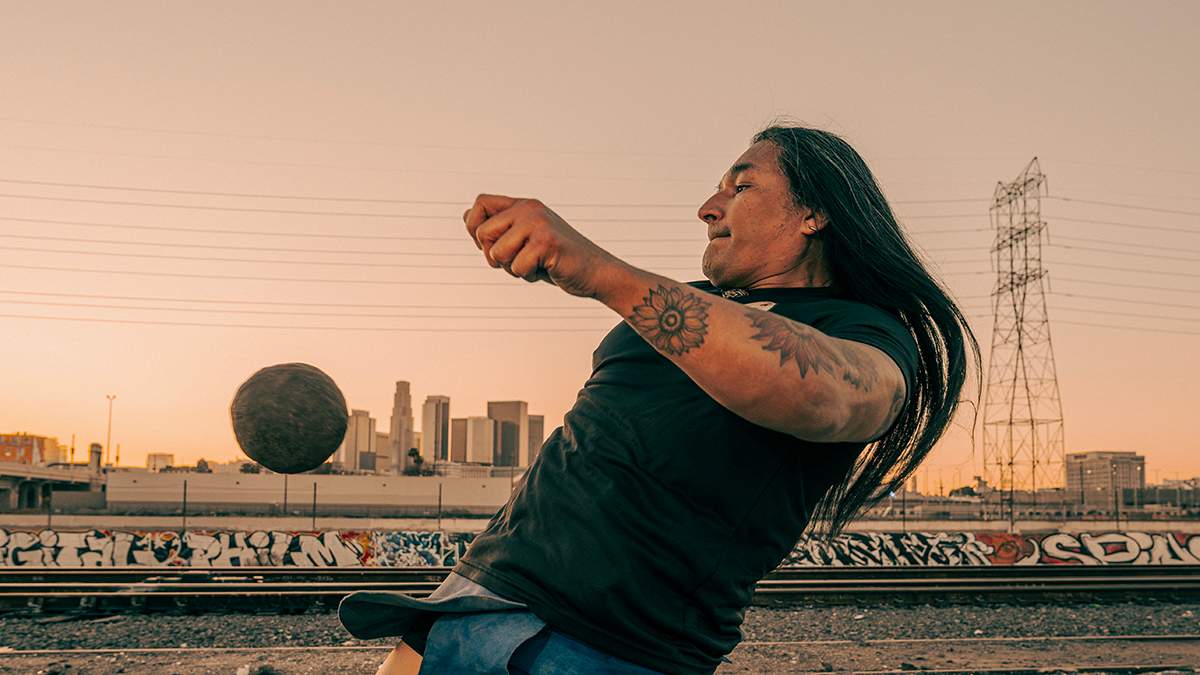
The photograph that won first place centers on a man playing one of the world’s oldest sports, the Mesoamerican ballgame Ulama. A 4,000-year-old tradition, Ulama nearly disappeared because of Spanish colonization and the twentieth century’s forces of modernization. It survived through the concerted efforts and embodied memories of Indigenous peoples and continues to be practiced in Mexico as well as California. As seen in the photograph, this game is often played in Los Angeles’s concrete channels and other types of large-scale, semi-derelict infrastructure that can operate as contemporary substitutes for the grand ball-courts or taste of the Aztec and Mayan civilizations (of which there are over 1,500 ruins in Mexico). It is this tension between ancient and modern, transient gesture and enduring tradition that animates this winning image. For how could it be that the oldest, most lasting element in this image is not the immobile cityscape of Los Angeles but the learned, athletic movement of a body? The kinetic grace of the player’s undulating body ruptures the rigid horizontality and orthogonality of the built environment but more potently explodes our preconceptions on what is im/permanent—a theme further elaborated by the tattoos and graffiti unfurling like chyron across the image. The photograph celebrates an ongoing decolonial process and conveys the joy of living and moving in a brown body. By doing so, it imbues gritty urban space with the pink of healthy fun—of hope, too, for all Angelenos.
Features
Thresholds 2026: Up Close and Personal will feature:
- In-Person Opening Reception & Panel Discussion – Thursday, May 7, 2026 at 6:30pm @ Helms Design District in Culver City, CA. RSVP HERE!
Price Sheet and Instructions for Purchasing Artwork
Download/view price sheet HERE.
Interested in purchasing artwork? Please email info@lacphoto.org and a representative will contact you ASAP. Thank you!
For questions please email info@lacphoto.org